Cultivating Belonging with Curriculum Resources/ 1 of 5
Lonely Youth: A Public Health Issue?
Loneliness among children and teens has been called a global phenomenon, a pressing issue, and even a public health crisis. Following the COVID-19 pandemic, when most K-12 students shifted to remote and socially-distanced learning models, parents, educators, and mental health professionals have expressed concern regarding the well-being and social connectedness of young people. Despite the return to in-person learning for the majority of students in the United States, worries about loneliness, isolation, and mental health persist. Recent research suggests that these concerns are warranted, and that students may be in need of greater support.
Statistics
- 1 in 4 teens reports feeling lonely (1)
- Loneliness has been shown to be a risk factor for depression in children and teens (1)
- 1 in 5 students reports ’feeling lonely or like an outsider or left out of things at school’ (1)
Belonging: A Complex Concept
Though the data surrounding student loneliness is troubling, fostering a sense of belonging at school may be a viable strategy to combat the issue. While scholars have yet to agree upon a single definition for what it means to feel as if one belongs, many educational researchers have cited Carol Goodenow and Kathleen Grady’s description: “the extent to which students feel personally accepted, respected, included, and supported by others in the school social environment.” (2)
Like loneliness, belonging has been linked to a number of outcomes for children and teens, including academic and mental health outcomes. In fact, belonging and loneliness may be inversely correlated among the K-12 student population: results from the OECD’s 2022 PISA report suggest that students who feel a stronger sense of belonging at school have lower levels of loneliness than students whose perceived belonging is low (3), and belonging at school has been shown to be a protective factor against loneliness among students. (4)
Though belonging is widely perceived to be a fundamental human need, a sense of belonging at school is not equitably experienced by all student groups. Students of color, female students, students with disabilities, and LGBTQIA+ students typically report lower levels of belonging. (5,6,7)
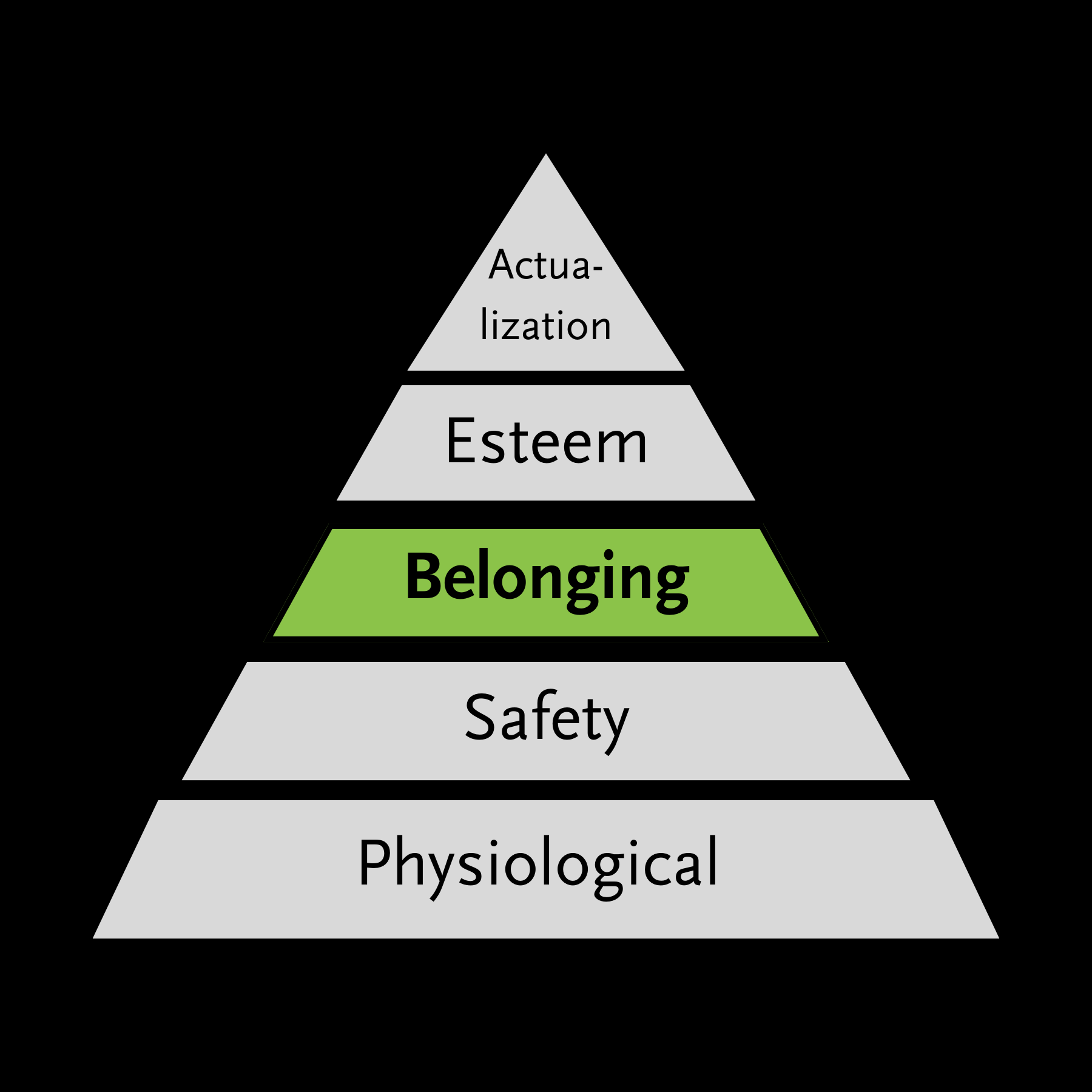
Caption: Abraham Maslow, a 20th-century American psychologist, devised the theory of the Hierarchy of Needs, which posits that all human beings share core needs that must be fulfilled to achieve one’s full potential. Often depicted as a pyramid, the hierarchy includes belonging as a key human need.
“On average across OECD countries, students who reported feeling safe and were not exposed to bullying or risks at school have a stronger sense of belonging at school, feel more confident about their capacity for self-directed learning and are overall more satisfied with life.” (3)
A sense of belonging is associated with (8):
- Psychological wellbeing
- Strong relationships
- Higher academic achievement
- Good physical health
By contrast, loneliness among children and adolescents has been linked to (8,9,10):
- Higher risk of mental and physical health problems
- Increased rates of anxiety
- Decreased self-esteem
- Lower life satisfaction
Footnotes:
- Gallup, Inc. (2023). The global state of social connections. Gallup.com. https://www.gallup.com/analytics/509675/state-of-social-connections.aspx
- Goodenow, C. & Grady K. (1993). The Relationship of School Belonging and Friends’ Values to Academic Motivation Among Urban Adolescent Students. The Journal of Experimental Education, 62(1), 60-71.
- OECD (2023), PISA 2022 Results (Volume II): Learning During – and From – Disruption, PISA, OECD Publishing, Paris, https://doi.org/10.1787/a97db61c-en.
- Beattie, M., Kiuru, N., & Salmela-Aro, K. (2025). Belongingness to groups, adolescent loneliness trajectories, and their consequences. International Journal of Behavioral Development, 49(3), 240–251. https://doi.org/10.1177/01650254241294019
- Poteat, V. P., Marx, R. A., Richburg, A., Calzo, J. P., Bliss, C. C., Yoshikawa, H., & Lipkin, A. (2025). Gender-sexuality alliance experiences and LGBTQ+ inclusive school policies and practices predict youth’s school belonging. Journal of Youth and Adolescence, 54(1), 1–16. https://doi.org/10.1007/s10964-024-02060-0
- Johnson, R. M., DeCuir-Gunby, J. T., Kenney, A. J., & Lyons, T. (2025). Black student belonging in K12 schools: Implications for policy and practice amid attacks on diversity, equity, and inclusion. Social Issues and Policy Review, 19(1), e70002. https://doi.org/10.1111/sipr.70002
- Barnes, R., Kelly, A. F., & Mulrooney, H. M. (2021). Student belonging: The impact of disability status within and between academic institutions. New Directions in the Teaching of Physical Sciences, 16. https://doi.org/10.29311/ndtps.v0i16.3607
- Allen, K.-A., & Furlong, M. (2021). Leveraging belonging in response to global loneliness. Australian Journal of Psychology, 73(1), 1–3. https://doi.org/10.1080/00049530.2021.1875532
- Maes, M., Nelemans, S. A., Danneel, S., Fernández-Castilla, B., Van den Noortgate, W., Goossens, L., & Vanhalst, J. (2019). Loneliness and social anxiety across childhood and adolescence: Multilevel meta-analyses of cross-sectional and longitudinal associations. Developmental Psychology, 55(7), 1548–1565. https://doi.org/10.1037/dev0000719
- Binte Mohammad Adib, N. A., & Sabharwal, J. K. (2024). Experience of loneliness on well-being among young individuals: A systematic scoping review. Current Psychology, 43(3), 1965–1985. https://doi.org/10.1007/s12144-023-04445-z