Cultivating Belonging with Curriculum Resources/ 2 of 5
Look around a typical U.S. classroom. What do you see?
In many of our public and private K-12 schools, we could expect to see students, teachers, desks, and chairs. Depending on the grade level and subject, we may see crayons, pencils, notebooks, backpacks, or lunchboxes. More than likely, we’ll also encounter a textbook. Whether curriculum appears in the classroom as a single textbook, perhaps accompanied by a teacher’s edition and ready-made unit quizzes, or as a set of shorter resources compiled to structure the year’s content, all curricular resources have one thing in common: they are inherently political materials (1).
When it comes to knowledge and education, nothing is neutral. Educational scholars have long argued that what and how we teach are directly linked to dominant ideologies regarding whose knowledge is valid, valuable, and legitimate.[Footnote 2,3] For too long, this has meant that minoritized groups have been either excluded entirely from being represented in curricular materials, or just as harmfully, been portrayed inaccurately and harmfully in ways that Other students who share these identities. We see this play out in classrooms in explicit ways, as in the case of “English only policies,” as well as in more subtle ways, such as when students’ cultures and identities are only deemed legitimate classroom knowledge during celebratory months, rather than being actively incorporated and validated throughout the curriculum. The latter, often called the “holidays and heroes” approach[Footnote 4] to multicultural curriculum, simply serves to trivialize the lives of marginalized people while reaffirming that the dominant culture, represented in the majority of the school’s curriculum, is the only legitimate school knowledge.
“Both classrooms and the curricula therein can reproduce oppression across all domains of power.”
– Dr. Eliana Castro, LSEHD ](5)
“Textbooks, especially when found in US public school settings, are inherently political documents. In some quarters, this would be a highly controversial, nay, inflammatory statement. And yet, the history of curriculum textbooks is filled with endless examples of just how politically oriented our instructional materials have been. From US history texts that extolled the virtues of slavery in the South to biology texts that skirt discussions of evolution, one can read the history of US textbooks as a political history of who has meaningful power to shape what is taught–and who does not. Furthermore, who is being represented in texts and how various sociological groups are represented are also determined by those with political power. Consequently, many historically minoritized groups have been portrayed in texts as “other,” as being “lesser Americans” be they African Americans, Hispanic Americans, all women, queers, and going back a mere 100 years, Irish Catholics.” (6)
Representation: A Necessary, But Insufficient, Shift
For minoritized students – including students of color, LGBTQIA+ students, disabled students, multilingual students, and immigrant students – being made invisible in the curriculum may contribute to a sense of non-belonging at school. Dr. Rebecca Eunmi Haslam, an educational equity scholar, reflects on her own experiences encountering only negative messages about her communities in school curricula:
“As a child, this left me wondering why I could not see myself reflected positively in the stories or curricula (or media, pop culture, elected leaders, or public art) around me….Messages about mattering are constant, implicit, omnipresent, and often define the school culture more than any policy, rule, or written statement” (3).
Though major textbook publishers have begun to diversify the images and content in their materials in recent decades, studies suggest that these changes have largely been superficial in nature. One 2018 study showed that health textbooks from leading K-12 publishers contained significantly more diverse imagery, with people of color and white people appearing in images at roughly the same rates, for example. Despite these statistical indicators of racial diversity in textbook images, the authors concluded that the representation was tokenistic in nature, without any critical engagement or meaningful representation of diverse ways of being and knowing within the texts (7).
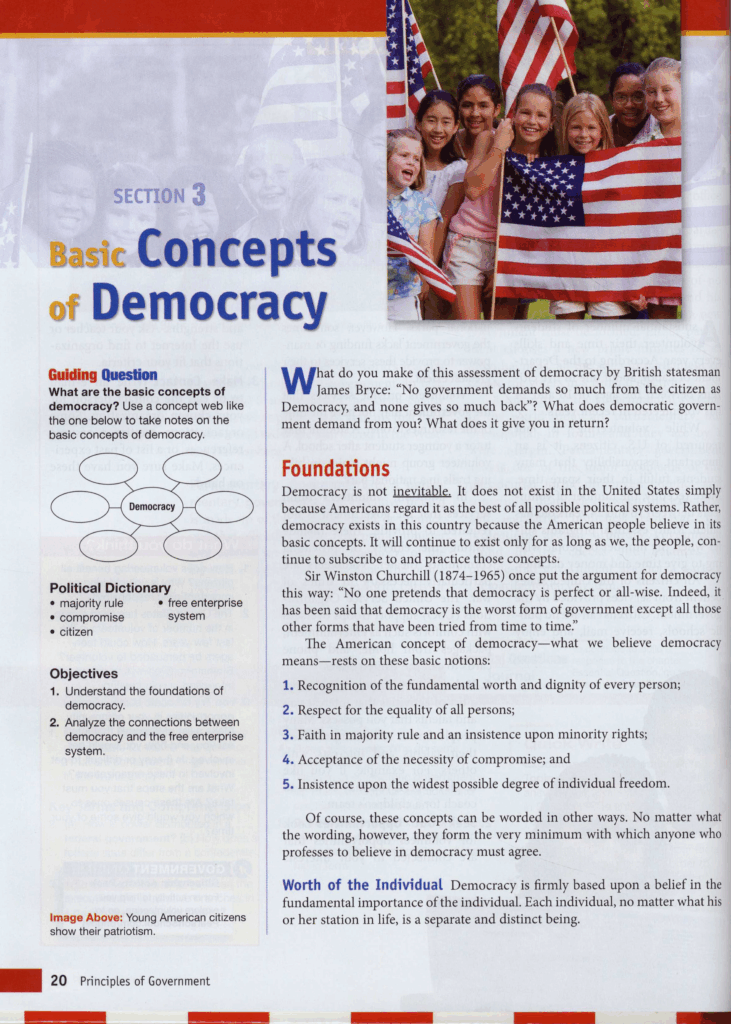
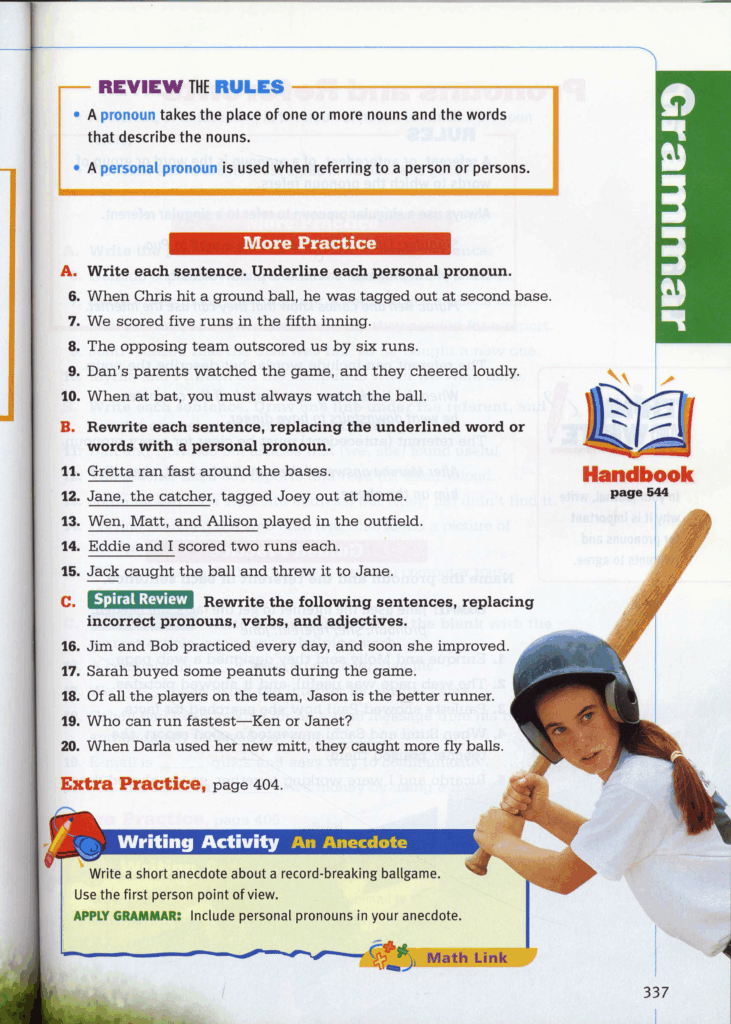
Caption: Left: A chapter in a 2013 high school social studies textbook depicts a multiracial group of children smiling and holding an American flag. Right: A 2005 language arts textbook depicts a student with a ponytail preparing to hit a baseball. Though textbook images have become increasingly racially diverse and tend to represent equal shares of male- and female-presenting individuals, research indicates that attempts to make curriculum meaningfully diverse are lacking.
Footnotes:
- Apple, M.W. (2004). Ideology and curriculum. Routledge.
- Apple, M.W. & Christian-Smith, L.K. (1991). The politics of the textbook. Routledge.
- Haslam, R. E. (2022). Critical representation: Mattering & belonging for students of the global majority. Middle Grades Review, 8(3).
- Banks, J.A. (2012). Encyclopedia of Diversity in Education. Sage.
- Castro, E. (2025). “I can’t just keep talking about the men”: Black girl resistance in the history classroom. Race and Ethnicity in Education, 28(1), 36-55.
- Lugg, C. (2012). Foreword. In H. Hickman & B. Porfilio (Eds.), The new politics of the textbook (pp. vii-ix). Sense Publishers.
- Deckman, S.L., Fulmer, E.F., Kirby, K., Hoover, K., & Mackall, A.S. (2018). Numbers are just not enough: A critical analysis of race, gender, and sexuality in elementary and middle school health textbooks. Educational Studies, 54(3), 285-302.